Finding a place to live for $500 a month in the United States is extremely challenging in 2026. National median rents for even a modest one-bedroom apartment sit well above $1,500 in most major metros, and total living costs (rent + food + utilities + transportation) for a single person usually exceed $1,500–$2,000 per month in lower-cost areas. A strict $500 budget almost always means focusing on rent alone — or sharing housing — rather than covering all expenses.
That said, there are still limited options if you are willing to live in small towns, accept basic or older housing, share space, or target the absolute cheapest markets.
Realistic Rent Options Near $500
True $500 or under rents for a private apartment are rare and mostly found in very small towns or declining industrial areas. According to recent data, Weirton, West Virginia has one of the lowest median monthly rents among ranked cities at around $548. Eagle Pass, Texas reports a median rent near $632, while Enid, Oklahoma sits around $686.
Even smaller places such as Roma in Texas, Crowley in Louisiana, Deming in New Mexico, and certain towns in Illinois, Michigan, and Arkansas show median rents in the mid-$500s range. In these locations, you may occasionally find older studio apartments, efficiency units, or small one-bedrooms listed near or slightly under $500, especially if the property needs updates. Mobile homes or trailers in rural parks can also fall into this price range in parts of the South and Midwest.
You can also check current low-cost apartment and room listings on Allinfohome, which features many affordable rental options across different states.
More Practical Ways to Stay Near $500
Most people who manage to keep their housing costs this low do so by making practical compromises rather than searching for a full private apartment at that price. The following approaches are the ones that work most often in today’s market.
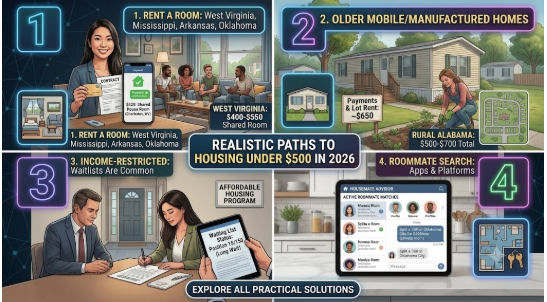
Renting a room in a shared house or apartment is one of the most realistic options. Private rooms in low-cost cities across West Virginia, Mississippi, Arkansas, Oklahoma, Alabama, and parts of the Midwest frequently list between $350 and $550, making this one of the more accessible ways to stay near the $500 mark.
Considering older mobile homes or manufactured homes in rural parks can also keep costs low. In many cases, the combination of lot rent and payments on the unit itself can stay close to the $500–$700 range, especially in less competitive rural areas of the South and Midwest.
Exploring income-restricted or subsidized housing is a further possibility for those who qualify. While these programs can reduce housing costs significantly, waiting lists are often long and available units tend to be limited.
Looking for roommate situations on platforms that specialize in shared housing is another practical path. These arrangements allow people to split the cost of a larger unit while still keeping a private bedroom, which can bring the individual monthly expense well below typical apartment rents.
The cheapest overall states for renters in 2026 continue to be Mississippi, West Virginia, Arkansas, Oklahoma, Alabama, and Kansas, where two-bedroom Fair Market Rents often fall in the $900–$1,100 range — still above $500, but far more affordable than coastal states.
The Trade-Offs of Living on a $500 Budget
Living this cheaply usually involves significant compromises that go beyond simply accepting a smaller or older home. The lower the housing cost, the more likely it is that other aspects of daily life will be affected.
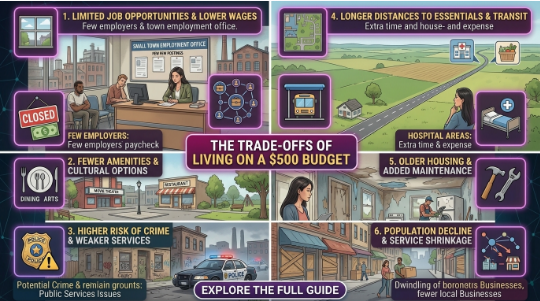
Limited job opportunities and lower wages are common in the cheapest markets. Many of these towns have fewer employers and less economic diversity, which can make it harder to find stable work or advance in a career.
Fewer amenities, restaurants, and cultural options are another frequent trade-off. Small or declining towns often lack the variety of shops, dining, entertainment, and community activities that larger cities take for granted.
Some of these places also carry a higher risk of elevated crime rates or weaker public services. While this is not true of every low-cost town, it is a factor worth researching carefully before relocating.
Longer distances to healthcare, grocery stores, or reliable public transit can add both inconvenience and extra expense. In rural or shrinking communities, basic services may be farther away and less frequent.
Older housing stock that requires more maintenance is another practical concern. Units priced near the $500 range are often older and may need more frequent repairs or updates, which can offset some of the rent savings over time.
Many of the absolute cheapest towns also face ongoing population decline. As residents leave, local businesses and services can shrink further, creating a cycle that makes daily life progressively less convenient.
Tips If You’re Serious About a $500 Housing Budget
If you are determined to keep housing costs close to $500 a month, a focused and realistic approach will improve your chances of success. The following steps can help you search more effectively and avoid common pitfalls.
Focus your search on small towns in West Virginia, Mississippi, Arkansas, Oklahoma, and rural areas of Texas or the Midwest. These regions consistently offer some of the lowest rents in the country and are the most likely places to find units or rooms near your target budget.
Use filters for “rooms for rent,” “shared housing,” or “under $600” on major listing sites and local Facebook groups. Narrowing the search this way helps surface the most realistic options and saves time that would otherwise be spent scrolling through full apartments priced well above $500.
Be prepared to visit in person, because the cheapest listings can be competitive or in rough condition. Photos and descriptions do not always reveal the true state of a property, and seeing it yourself reduces the risk of unpleasant surprises after signing a lease.
Factor in utilities, which can easily add $100 to $200 even in low-cost areas. Electricity, water, gas, and internet can push the total monthly housing expense higher than the base rent, so it is important to ask about average utility costs before committing.
Research local job markets carefully. Remote work can help, but many of these towns have limited high-speed internet options. Confirming both employment opportunities and reliable connectivity in advance will prevent major problems after you move.
Bottom Line
In 2026, living for a true $500 per month (covering rent only) is possible only in a narrow set of small towns or through shared housing arrangements. Places like Weirton, WV, and certain rural communities in the South and Midwest offer the best chance of finding housing near that price point. However, most people will need closer to $800–$1,200 for a basic private unit even in the cheapest regions, plus additional money for food, utilities, and transportation.
If your budget is this tight, prioritize shared housing, remote work that does not depend on local jobs, and thorough research into safety, internet access, and basic services before committing to a move